
Hidden Internet Risks and How to Manage Them 6
Beware of copyright infringement with P2P file sharing apps and software
What is P2P file sharing app/software?
Do you use any app or software that offers all-you-can-watch movies or a function to save your favorite videos?
Such apps and software may be using a structure called “peer-to-peer (P2P)” behind the scenes.
In such a case, you could unknowingly commit copyright infringement, which may result in you being billed for expensive damage compensation costs.
You may not be concerned with the topic because you do not know much about it. However, to protect yourself and your family, let’s learn about the P2P structure and how to prevent the associated risks.
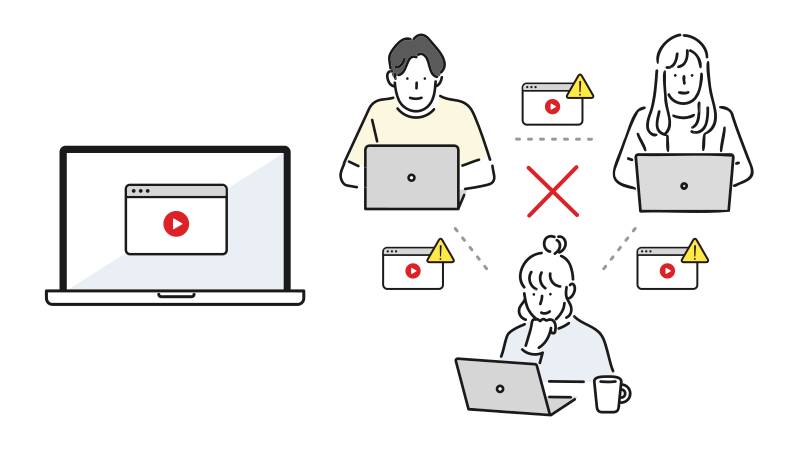
A structure that causes you to receive and distribute at the same time
P2P file sharing apps/software use a structure that allows you to directly exchange files with an unknown number of people over the internet. BitTorrent is one of the popular apps/software.
The key feature of this structure is that once a user downloads (or receives) a file, it simultaneously uploads (or distributes) that file to other people.
This means that your computer or smartphone automatically takes on the role of a file distribution hub for people around the world.
You can be the “offender” without knowing it
Most users only want to watch a video or save a specific file and do not intend to distribute files to other people.
However, as long as you use such an app or software, you will unintentionally be distributing copyright content (video, comics, music, etc.) without permission.
This is an act of copyright infringement – an illegal act committed without the permission of the copyright holder.
The number of damage claims due to copyright infringement is surging
When you connect to a P2P network, your communication record (such as IP address) is logged.
Based on the Information Distribution Platform Act (formerly the Provider Liability Limitation Act), copyright holders can use this communication record to request that the internet service provider disclose information about “who is subscribing to the line or who is using the communication”.
As a result, the subscriber’s name and address can be identified, and the number of expensive damage claims is surging.
How to prevent
There are three ways to prevent becoming involved in such unintentional trouble.

Beware of “free” and “all-you-can-watch” apps
Please beware of unofficial, unverified “free movie apps” and “file saving tools”.
Those apps may not include the word “P2P” or “Torrent” in their names, but may use the structure behind the scenes.
The most effective countermeasure is to “not download” or “not to allow the downloading of illegal files.”
Decide on family rules
Cases have been reported where a child or anyone who lives with the subscriber installs the app or software for convenience.
- Make a promise to watch videos only on official, authorized apps.
- Configure the settings to prevent the installation of apps or software on family computers and smartphones.
It is important for all family members to understand the risks of P2P file sharing apps and software, and have a rule not to use them.
Check your device settings
It is also important to be aware of peripheral devices such as Wi-Fi routers and network attached storage (NAS) devices.
Some products include a file sharing function as a default setting.
If such a function is enabled, you are at risk of files being distributed at any time, even when the computer is not in use.
Please check your device’s manual and turn off any unnecessary file sharing function.
Where to find help when you are uncertain
Troubles stemming from P2P file sharing apps and software are becoming a social problem, and public authorities are also raising awareness.
If you are uncertain about anything, please refer to the following contacts and reference websites.

Cautionary websites from related authorities
- Ministry of Internal Affairs and Communications (MIC): Is there a risk of copyright infringement from “just downloading a video”? (Only in Japanese)
- National Consumer Affairs Center of Japan: Are you using file sharing apps to watch videos? You might be infringing copyrights without knowing it!(Only in Japanese)
- Japan Internet Providers Association (JAIPA): Just watching is risky! The risky temptation of file sharing apps/software (Only in Japanese)
Consultation contact
- Consumer Hotline(National Consumer Affairs Center of Japan [NCAC]) (Only in Japanese)
- *You will be directed to your nearest consumer center or an equivalent service.
- IPA Safety Consultation Contact (Information-technology Promotion Agency, Japan [IPA])
- *A contact for consultation on technical issues such as viruses and unauthorized access.
Related Articles
-
Know the hidden internet risks. What should you do?
-
- 1. What is computer virus? What are the basic measures to take?
- 2. Spam email is sent to you without your choice. The number of unwanted, malicious spam emails is increasing.
- 3. New internet scams arise one after another. What are the details and how do you defend yourself?
- 4. What are the tricks of online identity theft and how do you manage them?
- 5. Your PC could also be targeted. Damage of unauthorized access and how to manage it.
- 6. Beware of copyright infringement with P2P file sharing apps and software